Policy Options and Reflections on the Future of 950 Phoenix Way
by Guy Dauncey
- Heavy Industry
- Protecting Nature
- Agricultural Operations
- Financial Considerations
- Next Steps
So, what happens now? A huge majority of people – 97% of participants – have said a clear and commanding “NO” to heavy industry anywhere near the Cable Bay Trail.
The challenge in crafting a revised zoning bylaw is not simply whether development occurs at 950 Phoenix Way, but what kind of development Nanaimo wishes to encourage in the decades ahead.
Eleven intensive hours of Public Hearing persuaded 8 of the 9 councillors to refer the rezoning motion back to staff and ask them to have another look at it, and bring back something better. So what is “something better?”
During the Public Hearing, seven themes constantly came up:
- Fear of the loss of trees, nature, and tranquillity;
- Fear of ocean contamination by toxic wastes;
- Fear of air pollution by toxic industries;
- Fear of industrial noise permeating the trail;
- The need for a larger forested buffer zone next to the trail;
- Fear that heavy industry, which the existing bylaw says specifically is not compatible with residential uses, will be allowed near residences in Cedar.
- The need for the Snuneymuxw First Nation’s free, prior, and informed consent.
It is my hope that possibilities raised in this report will be considered by the Snuneymuxw, and be included in their negotiations with Nanaimo Forest Products.
In this paper, I explore what’s possible in five areas: (1) Heavy Industry; (2) Protecting Nature; (3) Agricultural Operations; (4) Financial Considerations; and (5) Next Steps.
1. Heavy Industry
(a) Tightening the zoning by-law’s definition of ‘industrial’
Among the uses allowed in I-4 in Nanaimo’s zoning bylaw 4500 are chemical plants, industry, and petroleum processing. The word ‘industry’ is not defined. It could include a nuclear power plant, a biomass incineration plant, a waste-to-energy incineration plant, or an explosives factory. Activities such as these would increase air pollution, adding to the pollution from Harmac that often gives people a nasty taste in the mouth and forces them indoors with the windows shut.
One way to compromise is to amend the current industrial zoning bylaw to define “industry” more closely, with a view to protecting the health of Nanaimo’s citizens and nature’s many creatures. On November 17th 2025, council voted to support Councillor Manley’s motion to address this concern:
“That staff prepare a zoning amendment to Bylaw 4500 that prohibits the following industrial scale uses:
- Waste-to-energy incineration and garbage incineration facilities, excluding facilities that utilize biomass or gases created on-site as byproducts of production or manufacturing processes for cogeneration purposes.
- Chemical plants that produce emissions containing volatile organic compounds, nitrogen oxides, sulphur dioxides or other compounds that negatively affect human health or the environment.
- Thermal electricity generation from fossil fuels or biomass harvested solely for energy production purposes.
- Petroleum refineries.
- Liquefied natural gas (LNG) export facilities.
- Other emission-intensive industries with emissions that negatively affect human health or the environment.”
Some time back, I spent three years researching and co-authoring the book Cancer: 101 Solutions to a Preventable Epidemic, and co-founding the charity Prevent Cancer Now. There are so many ways in which toxic chemicals mix and interact, creating a carcinogenic mix.
There is clear logic to approving such an amendment, since Nanaimo’s OCP already contains commitments to environmental goals including clean air, clean water, zero waste, reduced light pollution, reduced climate pollution, and a green circular economy – to balance human wellbeing within Nature’s ecological limits.
There is precedent for this. The District of Highlands General Industrial Zone Bylaw, approved in by the province in 2024, includes the following prohibitions (11.1.2):
“In addition to the uses prohibited in Section 3.6 of this Bylaw, the following uses are expressly prohibited in the General Industrial (M1) Zone:
- Any uses considered offensive under the Health Act
- Refuse and garbage burning and landfilling
- Fertilizer, herbicide or pesticide manufacturing
- Refineries or bulk petroleum product manufacturing
- Bulk food product manufacturing
- Industrial uses within this Zone shall exclude “wrecking and salvaging” operations; and
- A use in this zone shall not ordinarily discharge or emit odorous, toxic or noxious matters or vapors, heat, glare, noise, vibration, smoke, dust, effluent or other emission hazards, electrical interference, or radiation across any lot line.”
If council were to vote in favour of such an amendment, some of the worst fears around heavy industry might dissipate for people living in south Nanaimo, Cedar, and on Gabriola and Mudge Islands.
The bylaw amendment should apply to all industrial land in Nanaimo, not just the land at 950 Phoenix Way. Nanaimo’s OCP clearly describes a community where the air is safe to breathe. If the amendment is not passed, an amendment to the OCP would be needed to remove the references to environmental goals.
The rejected zoning bylaw moved in this direction by including a list of prohibited uses in the ‘limited industrial uses area’, but the proposed area was only 50 metres wide alongside the trail and the southern boundary adjacent to the residential area in the RDN. That is woefully insufficient.
(b) Run-off: on-site, or into the ocean?
Regarding run-off, there was a contradiction in the proposed bylaw that needs addressing before a new version goes to 2ndReading.
The Aquaparian Environmental Assessment described 950 Phoenix Way as a site where the water stays mostly where it falls. The staff report, in line with this, said that development would be required to “maintain runoff at pre-industrial levels,” which means no net increase in runoff.
The Site Servicing Report, by contrast, proposed a fully engineered drainage system with ditches, pipes, and discharge points designed to collect the stormwater, along with any industrial contaminants, to pipe it off the site, and dump it in the ocean at Cable Bay.
As well as increasing chemical contamination of the ocean, where the orcas and sea-lions swim, an engineered drainage system would impact the wetlands, drying them out and eliminating the species that inhabit them.
The requirement to maintain runoff at pre-industrial levels should be written into the next version of the zoning bylaw, enforced through registration of a Section 219 Covenant.
(c) A Climate Action Development Permit Area
A development permit allows the City to review proposed developments to ensure that they meet the policies and objectives of the City Plan (OCP) and the City’s development permit guidelines. Nanaimo’s DPAs cover 8 themes, including Environmentally Sensitive Areas.
There is a 9th DPA that the city could use to regulate developments on industrial lands – a Climate Action DPA. The government’s Climate Action Best Practice Guidebook (2025) describes tools that local governments can use to this end. ‘Development Permit Areas for Climate Action’ contains useful guidance, establishing objectives to promote:
- Energy conservation;
- Water conservation;
- Reduced climate pollution (greenhouse gas emissions).
Climate action DPAs are being used by Fort St John, Lake Country, Langford, Richmond, Saanich, Sooke, Vancouver, and Whistler.
The Climate DPA supports the provincial government’s action on climate change, including requirement for local governments to have climate pollution reduction targets, policies and actions in their OCPs and Regional Growth Strategies. Nanaimo has already made the commitment to tackle the climate crisis. Climate Action DPAs could be used to help meet the City’s community-wide climate goal to reduce climate pollution by 50% by 2030.
At 950 Phoenix Way, a Climate Action DPA could be used to regulate the use of water and energy, encourage a circular economy (another OCP goal), and require zero net run-off, eliminating the need for an industrial outfall into the ocean.
The DPA could be combined with a Green Industrial Checklist and Scorecard attached to each permit application to ensure that businesses which lease the land align their operations with the city’s goals to reduce climate pollution, air pollution, water pollution, and wastes going to the landfill. This would enable the city to see which applications are strong and which are weak, work with applicants to improve their rating, and enable Nanaimo to regulate future industrial development through performance standards rather than land-use prohibitions alone.
(d) An Eco-Industrial Park
An eco-industrial park is a planned industrial area where businesses cooperate to reduce their environmental impacts, improve their efficiency, improve the quality of life for their workers, and save money by sharing resources, energy, water, materials, infrastructure, and services.
The goal is a circular economy in which the by-products of one business become inputs for another, minimizing pollution, resource use, and harm to surrounding ecosystems and communities, and increasing worker wellbeing.
Nanaimo includes the goal of building a circular economy in its OCP, so every rezoning or development permit application is an opportunity to work towards that goal, or to pretend that it doesn’t exist and stick to the old ways, ignoring the harmful impacts on nature and the planet.
If a compromise is to be struck, a commitment that new industrial-zoned lands are developed with this in mind, accompanied by zoning requirements and DPAs to ensure that development follows this model, would help to reduce people’s fears that once the land is zoned industrial, nature will be abandoned. The industrial lands leading up to Duke Point justify fears of what this could look like.
As well as the circular economy dimension of an eco-industrial park, there are human and ecological dimensions. Workers need places to relax and stretch their legs. If the land is developed with the protection of nature in mind, parts of the forest could remain, with cool, shared trails. Climate models indicate alarmingly that temperatures will become consistently warmer, and it may not be long before 40°C in summer is the norm on the Island, not the exception. The health and wellbeing or workers will be better protected if there are shaded forested areas, where the temperature may be 10°C cooler.
There is also extensive research which shows that access to nature, green space, clean air, and reduced noise improves mental health. It reduces stress, strengthens concentration, lowers anxiety, and improves our overall wellbeing. An eco-industrial park is not just better for nature — it is healthier for the people who work there.
Nanaimo Forest Products and the City could both benefit by requiring future industrial development to fit the eco-industrial model. Many companies want to do right for the planet and for their workers, as well as for their shareholders. This fits the bill. It is an opportunity to be taken wherever land in Nanaimo is zoned industrial.
A Climate Action DPA would require an amendment to the OCP at the time of rezoning. If this was thought to be too complex, staff or council could require a report on establishing an eco-industrial park, and the recommendations in the report could become a condition of rezoning, secured by the registration of a Section 219 covenant, the same way that the Aquaparian recommendations are being secured. If industrial zoning proceeds, Nanaimo would have the opportunity to become a Canadian leader in next-generation eco-industrial development.
- Wikipedia: https://en.wikipedia.org/wiki/Eco-industrial_park
- Burnside Eco-Industrial Park, Halifax.
- Kalundborg Eco-Industrial Park, Denmark
- Devens Eco-Industrial Park, Massachusetts
- Taiga Nova Eco-Industrial Park, Fort McMurray.
2. Protecting Nature
(a) Protecting all of the forest
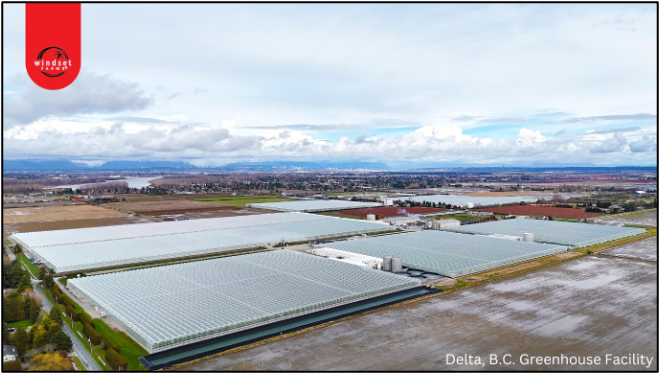
The 86 acres that Nanaimo Forest Products (NFP) own at 950 Phoenix Way are zoned AR-1. If council were to reject a new rezoning bylaw, NFP could potentially work with Windset Farms to develop a vast greenhouse operation, similar to their one in Delta, clearing most or all of the forest, in spite of the Environmentally Sensitive Area DPA.
NFP could also develop heavy industry on the lands they own immediately west of 950 Phoenix Way, which are already zoned I-4 heavy industrial.
It is impossible to see a scenario in which all of the forest at 950 Phoenix Way is protected, and there is no new heavy industry. Even if a donor showed up to buy the all the land and protect it as a park, there would still be heavy industry on the lands west of 950 Phoenix Way, releasing health-threatening air pollution.
(b) Protecting part of the forest
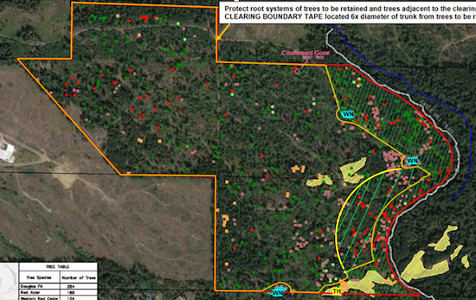
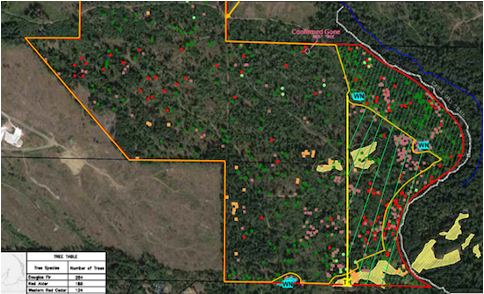
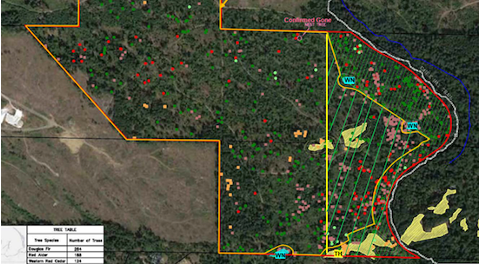
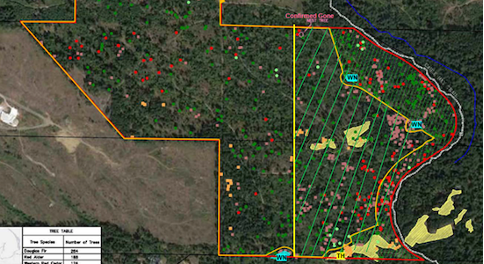
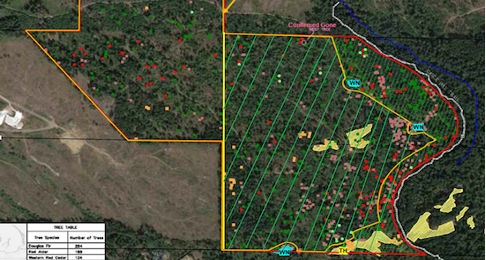
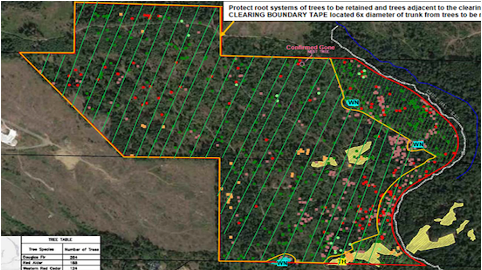
During the Public Hearing, many people shared the opinion that the average 100 metres buffer zone was inadequate, narrowing to 50 metres along much of the trail. If a compromise is to be crafted, a line will need to be drawn to delineate a new buffer zone, or parkland area. Here are six possibilities, ranging from a firm 100’ buffer to the entire land being zoned parkland.
The first five protect increasingly large areas of land as a park. In the sixth, if a donor was found to buy the land off Nanaimo Forest Products, the whole of 950 Phoenix Way could become a park, managed in a partnership between the City, the Snuneymuxw, and a Land Trust. The land could become a wonderful place for hiking, exploring, and learning about Nature, and all of the trees would be preserved, growing over time into an old growth forest. The amount of parking would need to be expanded, and shuttle buses might run from Nanaimo, Ladysmith, and Cedar.
(c) Protecting forested land during development
If one of the first five possibilities is adopted, the land east of the yellow line would be rezoned parkland, and the land west of the line would be rezoned industrial, hopefully with the prohibited uses described above.
To protect the lands during and after development, the March 23rd staff report required the registration of a Section 219 covenant to develop the property in accordance with recommendations in the Aquaparian report, and to provide a detailed Biophysical Assessment prior to any land-altering activity. These were the Aquaparian recommendations:
- Detailed design to refine the proposed development footprint including the vegetation clearing boundary, and confirm the tree buffer area, cut and fill requirements, stormwater management, road layout servicing requirements, and construction phasing.
- Environmental DPAs to be confirmed by the City. Anticipated impacts can then be confirmed to inform measures to avoid, mitigate or limit impacts, and compensate when required. Additional tasks include but are not limited to the following:
- A tree management plan to calculate removal and replacement requirements, based on the final design.
- If the two central meadows are to be lost, a rare plant specialist should conduct a spring/summer assessment to confirm that there are no protected species present.
- A pileated woodpecker nest cavity survey, and re-assessment to determine if any new eagle, heron or other raptor nests have been constructed, plus targeted studies such as migratory bird nest surveys, raptor nest surveys, bat roosting surveys, and amphibian surveys.
- A Construction Environmental Management Plan to provide mitigation recommendations during construction, including the identification of environmental least-risk timing windows; erosion and sediment control; spill prevention and waste management; soil management; vegetation management; air quality and dust control management; and Environmental Monitoring requirements and reporting.
The bottom line here is that in contrast to the way industrial land has been developed in the past, in which nature would be bulldozed away to create a blank slate, industrial development in the context of Nanaimo’s City Plan (OCP) requires that trees only be removed after the layout of roads and buildings has been confirmed – not before.
In this way, regulatory tools could be used to maximize protection of the tree canopy, both for ecological reasons and to keep the land under the canopy cool on hot summer days, when temperatures approaching 40°C will become increasingly common.
3. Agricultural Operations
(a) Temporary farm workers
The rejected zoning bylaw included permission for a Farm Operation and Temporary Farm Worker Housing. It included a provision so bad that it alone should have been sufficient to cause council to vote against it.
I am referring to the requirements for housing temporary farm workers. Section 13.3.1 (b) allowed up to 320 workers to live on site in the midst of heavy industry, even though the staff report clearly states that I-4 zoning is not suitable adjacent to residential neighbourhoods where people live. 320 people living closely together IS a residential neighbourhood.
Section 13.3.1 (c) stated that the maximum gross floor area allowed for housing was to be 10 square metres per worker. That’s roughly a 10-foot by 10-foot space. It’s not 10 square metres of bedroom space. It’s 10 square metres of gross floor area, including bedrooms, bathrooms, hallways, kitchens, laundry, and indoor common space. There are no bedrooms. There are “sleeping units”, which must mean bunk beds.
Temporary farm workers typically come from Mexico and the Caribbean. They are mostly male, aged 25 to 40, and married with children, whom they leave behind for 6-8 months a year. Once in Canada, they are usually excluded from normal labour protections.
The bylaw, if it had been approved, would have confined their sleeping space to a dormitory, and their living space to a building in the middle of heavy industry, surrounded by traffic, noise and air pollution. What would they have done in the evenings and weekends? It’s 12 kilometres to downtown Nanaimo. By bus, including walking to Cedar, it’s a 90-minute trip each way.
A home without transit in an industrial zone is a place of isolation, with no shops, sports facilities, or places to share a coffee. What would the cumulative health effects have been on the workers, living 24/7 amid noise, fumes and air pollution? At 5pm, they could not have gone home. This would have been their home. They would have lived there for months at a time.
The bylaw set maximum density, but not minimum livability. It breached Nanaimo’s OCP, which includes the goal that everyone will have the social foundation for a dignified life. The bylaw would have ensured that the temporary farm workers did NOT have a dignified life.
Some might call it a high-density labour camp. For an unknown reason, it was assumed that the greenhouse jobs could not have been taken by Nanaimo’s own people, 3,000 of whom, including 600 to 1,000 young people, are currently unemployed.
If these clauses reappear in the next version of the zoning bylaw, and the bylaw is approved, council risks a lawsuit on the grounds that living conditions that create a known risk to workers’ physical and mental health were knowingly and intentionally approved by this council.
(b) Light pollution
The Windset Farms greenhouses in Delta cover 92 acres, of which 48 acres are LED-lit. The plan is to increase this to 168 acres, 123 acres of which will be LED-lit. This is equivalent to 225 Canadian football fields. This tells us that the entire land at 950 Phoenix Way could potentially be covered in greenhouses.
Here’s one person’s experience of what happens at night, as told to the CBC: “On the darkest nights of winter when the cloud cover is just right, there’s a purple haze above parts of Metro Vancouver. I’ve never seen anything like it before. It’s a good thing I don’t face south, or I would have thought the United States was going up in flames.”
If council permits industrial greenhouses on the land without first setting up strict dark-sky protections, they will cause the permanent loss of the dark night sky to the glow of industrial lighting, visible for kilometres. The beauty of the stars at night is part of the public commons, and nature’s commons. Once lost to industrial light pollution, it will be extraordinarily difficult to reclaim.
Effective light-abatement systems exist, and could be incorporated into a new facility. With this in mind, before approving a new zoning bylaw, council should vote on a motion to use zoning, development permit conditions, or covenants to require:
- Greenhouse light pollution mitigation measures, including mandatory blackout curtains;
- Dark-sky compliance standards;
- Independent monitoring, with public reporting and meaningful penalties for non-compliance;
- Heat and ventilation management, requiring operators to demonstrate how excess heat will be managed without increasing ambient heat impacts on the surrounding ecosystems and neighbourhoods;
- A wildlife impact assessment regarding migratory birds, nocturnal wildlife, insects, amphibians, circadian disruption, and surrounding ecosystems;
- Adaptive management, requiring operators to implement additional measures if monitoring shows unacceptable ecological or community impacts after operations begin;
- Wide vegetated buffer zones between the greenhouses and surrounding forest, trails, wetlands, and residential areas, to reduce light spill and ecological disturbance;
- A formal public complaint mechanism, with mandatory investigation timelines and enforceable corrective actions.
4. Financial Considerations
(a) The Parkland Valuation
As staff prepare a new bylaw, I think it important that council consider how the buffer zone parkland was valued, since it determined the proposed Community Amenity Charge.
BC Assessment states that the 74-hectare property at 950 Phoenix Way is assessed at $3.4 million. On that basis, the proposed 11.3-hectare buffer-zone, occupying 13% of the land, had an assessed value of some $440,000.
Under the Assessment Act, land is assessed based on its actual market value, given its legal use. If the buffer is rezoned to parkland (PRC-1), its use will be permanently restricted. It cannot be developed, and will have no meaningful market value. In assessment terms, that typically results in very low or nominal value.
Rezoning land to parkland does not create land value uplift. It removes it. Since there is no uplift, there should have been no Community Amenity Charge tied to the land.
The staff report for the rejected bylaw calculated a Community Amenity Charge of $4.4 million for the entire parcel, based on the uplift created by rezoning to industrial at an assumed $34 per m2 of industrial gross floor area. The CAC applied to Phase 1 of the development only, not to Phases 2 and 3. This was not made clear.
The report then strangely stated that the proposed parkland has an assessed value of $2.09 million, and used that figure to reduce the $4.42 million CAC owed by the landowner to $2,330,000.
This was strange, and not financially prudent. The buffer was being treated as parkland for land use purposes, but valued as developable industrial land for financial purposes. They cannot both be true.
Furthermore, if 13% of the land was assigned a value of $2.09 million, 100% of the land should have been assigned a value of $15 million, not $4.4 million.
That is $10.6 million of public value that Council would have voted away had the bylaw not been deferred for more discussion, plus $1.65 million voted away due to the faulty valuation of the buffer zone at $2.09 million rather than $440,000. Taken together, Nanaimo taxpayers would have lost $12.25 million.
(b) The Community Amenity Contribution
This may be confusion on my part if there was an intention to levy a CAC on Phases 2 and 3, but as I understand it, CACs were only allowed to be charged at the point of rezoning, so a future CAC would not have been legally possible.
The staff report (Page 5) said, “Once development on the lot exceeds the assessed value of the lands to be dedicated as park, any CACs beyond the $2.09 million will be provided in the form of a monetary contribution.” This assumes that “the assessed value of the lands to be dedicated as park” is the “as-if-industrial” value, not the actual parkland value.
Under the rejected bylaw, Council would have been granting industrial zoning, creating land value uplift, and allowing Harmac to claim compensation for not using part of the uplift that would not have been allowed anyway. The buffer zone was being valued as if the rezoning benefit had been realized as industrial, and credited back to the developer as a deduction. This makes no sense.
It is my understanding that Community Amenity Agreements are to be replaced with Amenity Cost Contributions (ACC), which will be charged each time there is a building permit application, enabling a share of the future land value uplift in Phases 2 and 3 to be reclaimed by the City.
The new ACC is $63.48 per industrial gross floor area, so use of the $34 number, because the application was made in 2023, would have deprived the City of half the contribution it could have received under the new ACC.
The City’s DCC/ACC website page (“What happens to applications already in process?”) says: “When a new DCC Bylaw and/or ACC Bylaw is enacted, an existing development application submitted prior to the adoption of the new Bylaw(s) is granted 12-month in-stream protection.” It continues:
“In-stream protection will apply to both building permit and subdivision applications received prior to the adoption of any new DCC Bylaw and/or ACC Bylaw. Protection is also extended to rezoning and development permit applications that were submitted prior to the adoption of any new DCC and/or ACC Bylaw and that will result in a building permit within 12 months of bylaw adoption. If an application meets the required criteria of being submitted prior to the adoption of the new DCC Bylaw and/or ACC Bylaw, it is provided protection from rate increases.”
I may be wrong here, because this gets complicated to understand, but since the rezoning application for 950 Phoenix Way was made in December 2023, more than 12 months ago, it tells me that the ACC industrial rate of $63 should have been applied to building permit applications at 950 Phoenix Way. This also tells me that the total ACC for Phases 1, 2 and 3 could have been a LOT more than $4.4 million listed in the staff report. I wrote to Poul Rosen, Director of Engineering, on May 5th to seek clarification on this, but I have not heard back.
(c) $34 per Square Metre
The valuation of the land at $34 per square metre of industrial gross floor area in Phase 1 of the development was the basis for the Community Amenity Contribution, and the $4.4 million evaluation for 130,000 square metres of potential floor area in Phase 1. The $34 number came from “Community Amenity Contribution Policy” that was approved by Council in November 2021.
$34 does not represent the market value of the land. It is a rate designed to capture a portion of the financial uplift that is created by Council and gifted to the landowner through the act of rezoning.
The land is currently worth $5 to $20 per square metre. After rezoning to industrial it will jump to going price for unserviced industrial land in the region, which I gather is $50 to $100 per sq. m..
The $34 is charged on gross industrial floor area. In a typical industrial development, 40% to 60% of the land becomes building space, so $34 per square metre of floor area is equivalent to $14 to $20 per square metre of land. This compares to the post-rezoning value of $50 to $100 per sq. m..
Using the $34 number, staff proposing retaining 20% of the increased value, giving Nanaimo Forest Products 80%, a 1:5 split in favour of NFP. What is the origin of this arrangement? Was council aware of this when they adopted the CAC formulation in 2021?
Thanks to the motion to refer the zoning bylaw back to staff, this is now history. In a revised zoning bylaw the CAC will be replaced by an ACC, which uses $63.48 as its assessed value number, not $34.
$63 per square metre of floor area is equivalent to $25 to $38 per square metre of land, compared to the post-rezoning value of $50 to $100 per square metre of land. The new balance would reduce the split to between 1:4 ($25 uplifted to $100) in favour of NFP, and 38:50 ($38 uplifted to $50) in favour of the city.
The 75 hectares (750,000 square metres) that was to be zoned industrial would have had a post-rezoning value between $37.5 million and $75 million, assuming $50 to $100 per square metre.
If the buffer zone is doubled (for example) from 11.3 to 22.6 hectares, reducing the industrial land by 11.3 hectares, the post-rezoning value would be between $32 and $64 million.
If council claimed 50% of the uplift value for the city, using a flexible formula that captured the real value at the time of sale, or the annualized leasehold value at the time of leasing, the benefit to Nanaimo’s taxpayers would be between $16 and $32 million.
5. Next Steps
In a marriage, as one of the speakers said at the Public Hearing, when there is a disagreement, the first step should always be the same: to sit down and talk. Listen to each other, learn each other’s perspective, and work to craft an agreement.
Prior to the Public Hearing there was just one Public Information Meeting with the community, in October 2024, following which Nanaimo Forest Products added agriculture as a site-specific use, and created an approximately 50 metres wide “lighter industry” zone adjacent to the buffer zone.
It also became apparent that the Snuneymuxw First Nation had not concluded their negotiations with NFP, and that NFP had not obtained their free, prior, and informed consent.
The next step should be for the city to invite representatives from Nanaimo Forest Products, the Snuneymuxw, and Save Cable Bay to sit down with staff and council to talk, listen, and learn.
Let me end by allowing Nanaimo’s OCP speak for us all.
Crafted by many people over several years, it views city-building as a collaborative civic process that needs to be grounded in shared community values, ongoing public engagement, collective learning, and inclusive dialogue: “Great cities aren’t created by accident,” it says. “They are built by residents collectively creating a vision and road map for their city’s future.”
The City Spark Public Engagement Strategy that was used to build the OCP included a clear commitment to dialogue and engagement:
- “Bringing the range of voices that represent Nanaimo together into a community conversation is essential to developing a shared and broadly supported plan for the future.”
- “Learning from community residents is vital to building a shared vision for the future.”
- “Facilitate an inclusive, transparent engagement process that focuses on identifying shared values towards building a common direction.”
- “Reflect all the voices of our community.”
- “Our City, Our Voices.”
So let’s do it: let’s talk.
And for future projects like this, let’s talk before a controversial zoning bylaw goes to the Public Hearing, not after.
With appreciation for all the work that council and staff put in.
Guy Dauncey 13561 Barney Rd, Ladysmith V9G 1E9
250-924-1445


who is representing the neighborhood directly affected by these proposals?
I see a recommendation for Snuneymuxw and the Save Cable Bay group invited to the table in the next steps, with no representation for those of us the actually will need to live day-to-day next door to these changes affecting our 24hr day to day lives, our health and well being, and our property values?
We have been completely overlooked from the beginning and continue to be, with the experience of creating a buffer to protect a visitor to the area takes precedence over the humans that live directly next to it, we have issue as neighbours to the proposal. The fact we are not even being invited to the table once again shows, we don’t seem to matter, and will continue to be overlooked.
LikeLike