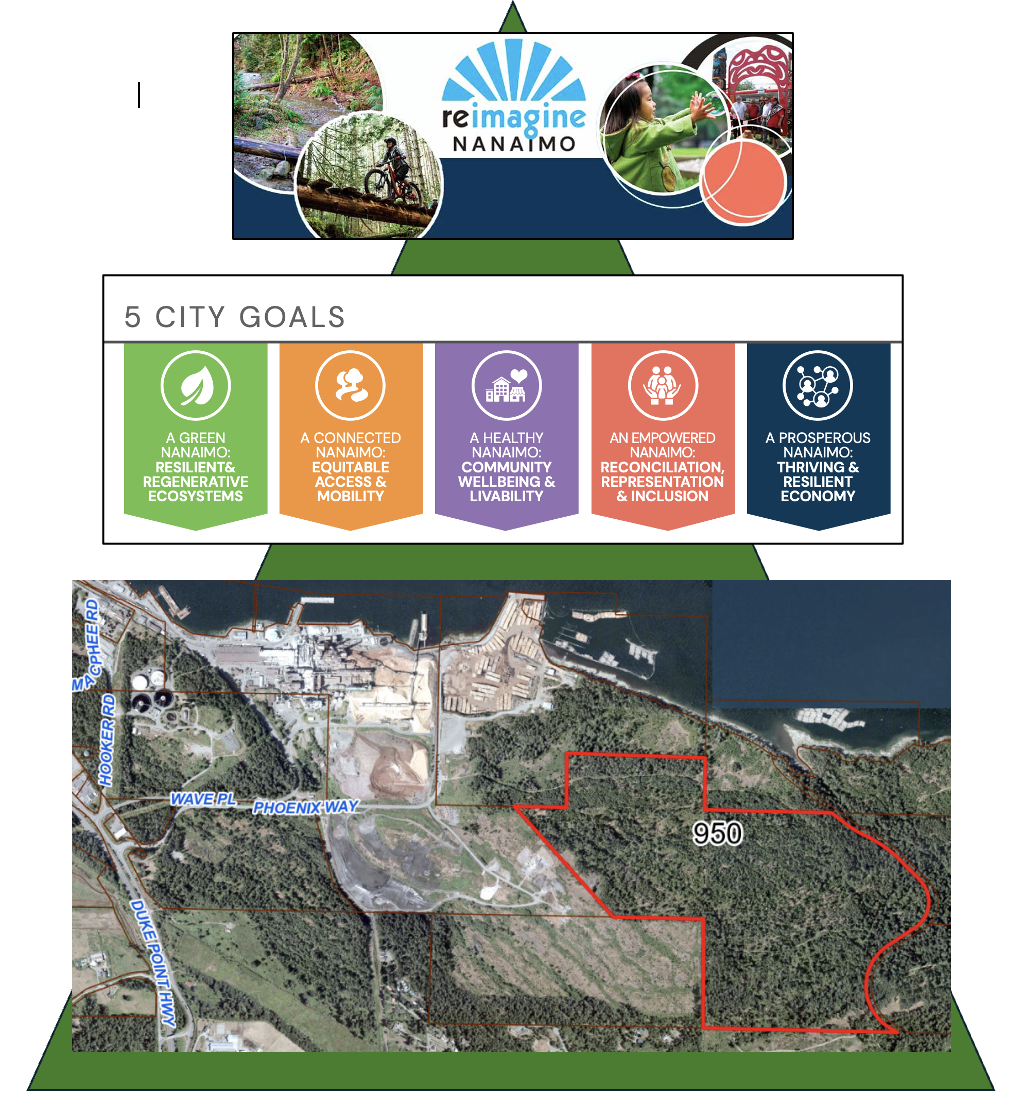
Policy Options and Reflections on the Future of 950 Phoenix Way
by Guy Dauncey
Heavy Industry
Protecting Nature
Agricultural Operations
Financial Considerations
Next Steps
So, what happens now? A huge majority of people – 97% of participants – have said a clear and commanding “NO” to heavy industry anywhere near the Cable Bay Trail.
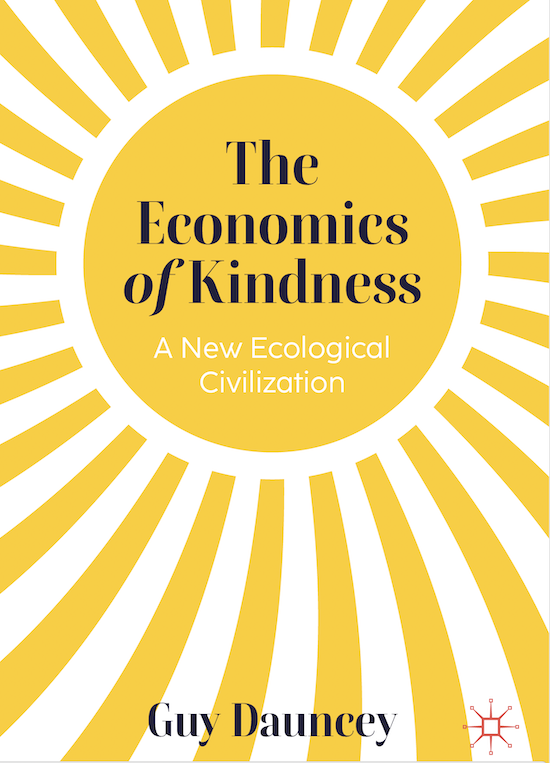
Our world needs more kindness. People need more kindness. Nature needs more kindness. But we need it deep within our economies, where so many of our troubles begin.
We have been told a thousand times that the free-market economy is the best possible kind of economy, but for so many people, and for nature, it’s just not working. Surely, there must be a better way. Our capitalist economy has been built on the primacy of selfishness. What is the alternative? In this book, I hope to convince you that it’s the economics of kindness, which we can use to achieve massive transformative change and build a new ecological civilization. And it’s not just an idea. It’s a very real thing.
But first, we must address the question that’s causing so much anxiety: why are things in such a mess? We’ve got the rising cost of living, the housing crisis, and the ridiculous increase in inequality alongside the tax-avoiding billionaires. We’ve got increasing loneliness. We’ve got refugees, and desperate immigrants. In America, we’ve got oligarchy, kleptocracy, and billionaires who believe they are entitled to rule the world. And all the while, with ominous drumbeats of warning, we’ve got the climate crisis, the collapse of biodiversity, and the reality that we are overshooting Earth’s ecological boundaries. And the horrible ongoing wars. And just when we need calm decisive action, we’ve got social media chaos, increasing anxiety, anger, and hate.
When young Canadians aged 16 to 25 were surveyed in 2022, almost three quarters said they felt frightened about the future. So enough! It is time for change. Time for determined hope. Time for moral ambition, as the Dutch historian Rutger Bregman puts it in his clarion call to action In the pages of this book you will find a solid analysis of how we got into this mess, and a practical guide for not just how we can get out of it, but for how we can build an economy based on cooperation and kindness, as the foundation for a new ecological civilization.
But first, how to make sense of things? A thousand philosophers have offered a thousand answers, but our troubles seem only to get worse. The year 2073 beckons, if you’ve seen Asif Kapadia’s dark movie: democracy obliterated, minorities silenced, dissenters arrested, social media co-opted. The billionaires are having a field day, but billions are struggling, growing angrier and more resentful by the day. Some become extremists who want to tear it all down. A violent coup against democracy that would have been unthinkable ten years ago is now a present possibility in some countries. We need to peel back the myriad symptoms of dysfunction, and discover what’s driving them.
Guy Dauncey is founder of the BC Sustainable Energy Association, co-founder of the Victoria Car Share Cooperative, and the author or co-author of ten books, including The Climate Challenge: 101 Solutions to Global Warming and Journey to the Future: A Better World Is Possible. He is currently completing The Economics of Kindness: A Ten-Year Transition to a Green Cooperative Economy. He lives in Yellow Point, on Vancouver Island, Canada. His website is www.thepracticalutopian.ca.
I premise my analysis on five statements:
The climate emergency is real.
The ecological emergency is real.
The inequality, household debt and affordable housing crises are real.
A new global financial crisis is lurking, caused by excessive corporate and private debt and banking deregulation.
We need a ten-year mobilization to achieve a rapid transition to a green cooperative economy that is human-friendly, community-friendly, climate-friendly and nature-friendly, leaving self-interested capitalism behind us.
There are massive forest fires in Siberia. Greenland’s melting is accelerating. Record heatwaves are roasting Europe. The world’s insects are dying off. The scary news keeps accumulating.
We are living on the edge of an emergency that is just getting started, and climate is only the half of it. There’s also an ecological emergency. How are we to respond? It’s easy to slip into complacency, or to be overcome by fear, followed by a sense of impotence. You know the crises are real, but the children are coming to visit, there’s a holiday to plan, and don’t get me started on the problems we’re having at work.
The first step to end complacency and neutralize fear is to put the crisis on your weekly to-do list:
Weed the garden
Visit your friend in hospital
Sign the kids up for karate/soccer/piano/dancing lessons
Do something to tackle the climate and ecological crises
What does it mean to be so worried, because you really can’t afford the rent? To have to surrender your hope of ever owning a home? To face the end of a rental lease and know that there is NOTHING out there that you can afford? To stare homelessness in the face?
Many of us are comfortably housed, but many are not. The autumn rains have arrived, and the harvest crops are being gathered in. Everyone seems to be getting on with their lives. And yet for many people, the smiles and kindnesses that make life worth living mask a level of stress and worry that should have no place in our community.
How can it be that in this Cowichan Valley that we love so much, there is such a housing crisis? How can democracy, the housing market, and local government have failed us so completely?
What does it mean to be so worried, because you really can’t afford the rent? To have to surrender your hope of ever owning a home? To face the end of a rental lease and know that there is NOTHING out there that you can afford? To stare homelessness in the face?
Many of us are comfortably housed, but many are not. The autumn rains have arrived, and the harvest crops are being gathered in. Everyone seems to be getting on with their lives. And yet for many people, the smiles and kindnesses that make life worth living mask a level of stress and worry that should have no place in our community.
How can there be such a housing crisis?
How can it be that in this Cowichan Valley that we love so much, there is such a housing crisis? How can democracy, the housing market, and local government have failed us so completely?
Submission to the Agricultural Land Reserve Minister’s Advisory Committee by Guy Dauncey and Rob Buchan. Deadline for letters and submissions Monday April 30th 2018.
Throughout the world, in every culture, farmers have lived and raised their children in small farm villages.
Here on Vancouver Island, 95% of our food is imported every day on the ferries. At the same time, good farmland sits empty or grows hay, while younger people who want to get onto the land to grow food are unable to do so because of the incredibly high price of land.
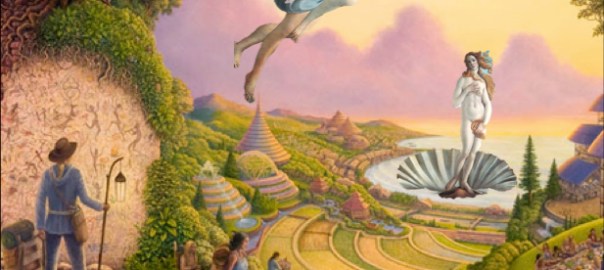
If you want to see what this EcoRenaissance looks like on the ground, click HERE.
Until a thing has a name, it doesn’t really exist
I can feel this future. I have written a novel about it. I love its colour and vibrancy, its harmony with Nature. But what is its name?
One of the realities of the spoken language is that until a thing has a name, it doesn’t really exist. When we want to create something, we name it.
The feeling that comes to mind is one of Renaissance – the birth of a new vision, the promise of a new future. The Renaissance that was seeded in the 13th century and blossomed into glory in the 15th and sixteenth centuries filled people’s hearts, souls and minds with art, imagination and ideas. It took inspiration from the rediscovered science, art and philosophy of ancient Greece and Rome. It made souls take flight, washing away the dull dogmatism and cruel muddy feudalism of a world where nothing much changed except by disease, disorder and death.
Guy Dauncey is the author of Journey to the Future: A Better World is Possible and nine other books. He is an Honorary Member of the Planning Institute of BC and a Fellow of the Royal Society for the Arts.
June 2017. This is an updated and expanded version of Canada’s Housing Crisis: 22 Solutions, originally published on The Practical Utopian in December 2016.
Canada’s housing crisis is far more severe than most people realize. The fundamental problem is an excess of money pouring into the housing market from various sources, combined with an abdication of responsibility by all levels of government for the past 30 years.
There are many on-the-ground solutions, demonstrating positive ways to build affordable housing. And there are seven new housing-related taxes that could raise the funds needed for a massive expansion of affordable housing.
The fundamental cause of the problem is the excess of funds flowing into the market, and until this is solved house prices will continue to rise, and most other solutions will seem like never-ending sandbagging.
The money supply problem can be solved. The money can be obtained to restore safe, sustainable, socially designed affordable housing as a fundamental human right.