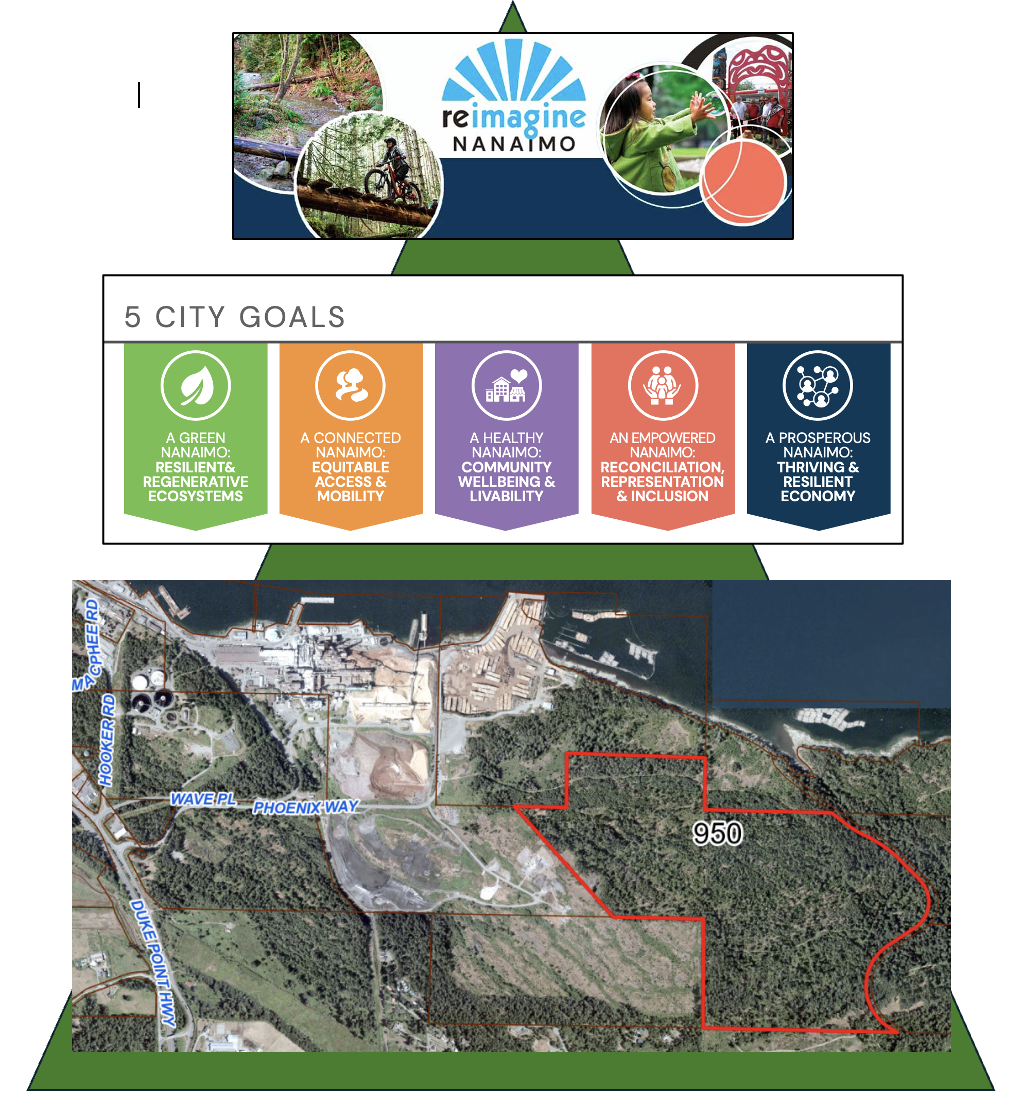
Policy Options and Reflections on the Future of 950 Phoenix Way
by Guy Dauncey
Heavy Industry
Protecting Nature
Agricultural Operations
Financial Considerations
Next Steps
So, what happens now? A huge majority of people – 97% of participants – have said a clear and commanding “NO” to heavy industry anywhere near the Cable Bay Trail.
There is a craziness afoot in British Columbia, and I’m not referring to the legions of homeless people who are camped out on our streets. I’m referring to the $3 billion of public money that is about to be spent on a transmission line to carry electricity from the Site C Dam to Prince Rupert. Are the good folks of Rupert planning to mine cryptocurrencies? Build a nuclear power plant? No. It’s a cryptocarbon-busting innovation they want to build, using a digital deception to transform fracked fossil gas into “the world’s cleanest LNG”.
Do you bank with Community Coastal Credit Union? If you do, congratulate yourself. A credit union is a financial cooperative that is – or could be, if you vote – controlled by its members, for your benefit and the benefit of the wider community.
As a shareholder, you have the right to vote for CCCU’s Directors – and the 2024 election is happening NOW!
Our world needs more kindness. People need more kindness. Nature needs more kindness. But we need it deep within our economies, where so many of our troubles begin.
We have been told a thousand times that the free-market economy is the best possible kind of economy, but for so many people, and for nature, it’s just not working. Surely, there must be a better way. Our capitalist economy has been built on the primacy of selfishness. What is the alternative? In this book, I hope to convince you that it’s the economics of kindness, which we can use to achieve massive transformative change and build a new ecological civilization. And it’s not just an idea. It’s a very real thing.
But first, we must address the question that’s causing so much anxiety: why are things in such a mess? We’ve got the rising cost of living, the housing crisis, and the ridiculous increase in inequality alongside the tax-avoiding billionaires. We’ve got increasing loneliness. We’ve got refugees, and desperate immigrants. In America, we’ve got oligarchy, kleptocracy, and billionaires who believe they are entitled to rule the world. And all the while, with ominous drumbeats of warning, we’ve got the climate crisis, the collapse of biodiversity, and the reality that we are overshooting Earth’s ecological boundaries. And the horrible ongoing wars. And just when we need calm decisive action, we’ve got social media chaos, increasing anxiety, anger, and hate.
When young Canadians aged 16 to 25 were surveyed in 2022, almost three quarters said they felt frightened about the future. So enough! It is time for change. Time for determined hope. Time for moral ambition, as the Dutch historian Rutger Bregman puts it in his clarion call to action In the pages of this book you will find a solid analysis of how we got into this mess, and a practical guide for not just how we can get out of it, but for how we can build an economy based on cooperation and kindness, as the foundation for a new ecological civilization.
But first, how to make sense of things? A thousand philosophers have offered a thousand answers, but our troubles seem only to get worse. The year 2073 beckons, if you’ve seen Asif Kapadia’s dark movie: democracy obliterated, minorities silenced, dissenters arrested, social media co-opted. The billionaires are having a field day, but billions are struggling, growing angrier and more resentful by the day. Some become extremists who want to tear it all down. A violent coup against democracy that would have been unthinkable ten years ago is now a present possibility in some countries. We need to peel back the myriad symptoms of dysfunction, and discover what’s driving them.
This is an extract from Chapter 12 of my forthcoming book The Economics of Kindness: How to End the Economics of Selfishness and Build an Economy that Works for All, for which I am seeking a publisher.
So much has been written about the urgency of the looming climate disaster that I’ll skip straight to the solutions. I am a climate alarmist, just as Churchill was a Nazi alarmist in the 1930s. But I am not a climate doomer. I am of one mind with Paul Hawken, author of Regeneration: Ending the Climate Crisis in One Generation,who believesthat we can do this if we put our minds to it. The alternative is too dire to contemplate.
Guy Dauncey’s Big Solutions: Raising interest rates is a cruel cudgel that hurts the most vulnerable. There are other responses that governments and central banks should consider.
First Published in Planning West (PIBC), Summer 2022
By Guy Dauncey PIBC (Hon); Rob Buchan Ph.D., FCIP, RPP; Jack Anderson MCIP, RPP; Heather Pritchard; Kent Mullinix Ph.D. August 2022
There’s a global food catastrophe coming our way, and we’re not ready for it. It’s being caused by a disastrous combination of climate-induced deluges, droughts and heat waves; the war in Ukraine; supply-chain disruptions; and food export bans by leaders who are worried about popular insurrections if they can’t feed their people. Meanwhile, farmers’ profit margins are being squeezed by the rising cost of fuel, fertilizer and animal feed.
It’s sunset, at the end of another beautiful day in Honolulu. The high tide is arguing with the seawall, which was raised another metre last year to protect the Capitol Building – but what’s new? They’re still not on good terms with each other.
My name is Ben Danner-Pualani, and tomorrow I will give the biggest speech of my life in front of all my peers. They say it will be broadcast to every schoolchild. I’m 87, and for my sins I have been granted the pomposity of being a Senator, so I’ve seen a bit, but this has the butterflies crawling all over my poor weak heart, under my great grandfather’s ancient robe.
In his book, Value(s): Building a Better World for All, former governor of The Bank of England Mark Carney, looks at value beyond dollars and demands your attention. Review by Guy Dauncey. First published in The MINT Magazine, September 2021.
When the world’s best-known central banker writes a new book, we should sit up and pay attention, especially since Mark Carney is one of the few central bankers who really gets the climate crisis.
It’s a quite personal book; his writing reveals a deep commitment to ethical values, and service to the wider community. He makes me feel that I know him, and we’d get along well over a pint of beer. He often shares stories from his time at the Bank of England, and as chair of the Financial Stability Board, which was set up after the 2008 financial crash, resulting in over 100 reforms. Will they work? Time will tell.