There is a craziness afoot in British Columbia, and I’m not referring to the legions of homeless people who are camped out on our streets. I’m referring to the $3 billion of public money that is about to be spent on a transmission line to carry electricity from the Site C Dam to Prince Rupert. Are the good folks of Rupert planning to mine cryptocurrencies? Build a nuclear power plant? No. It’s a cryptocarbon-busting innovation they want to build, using a digital deception to transform fracked fossil gas into “the world’s cleanest LNG”.
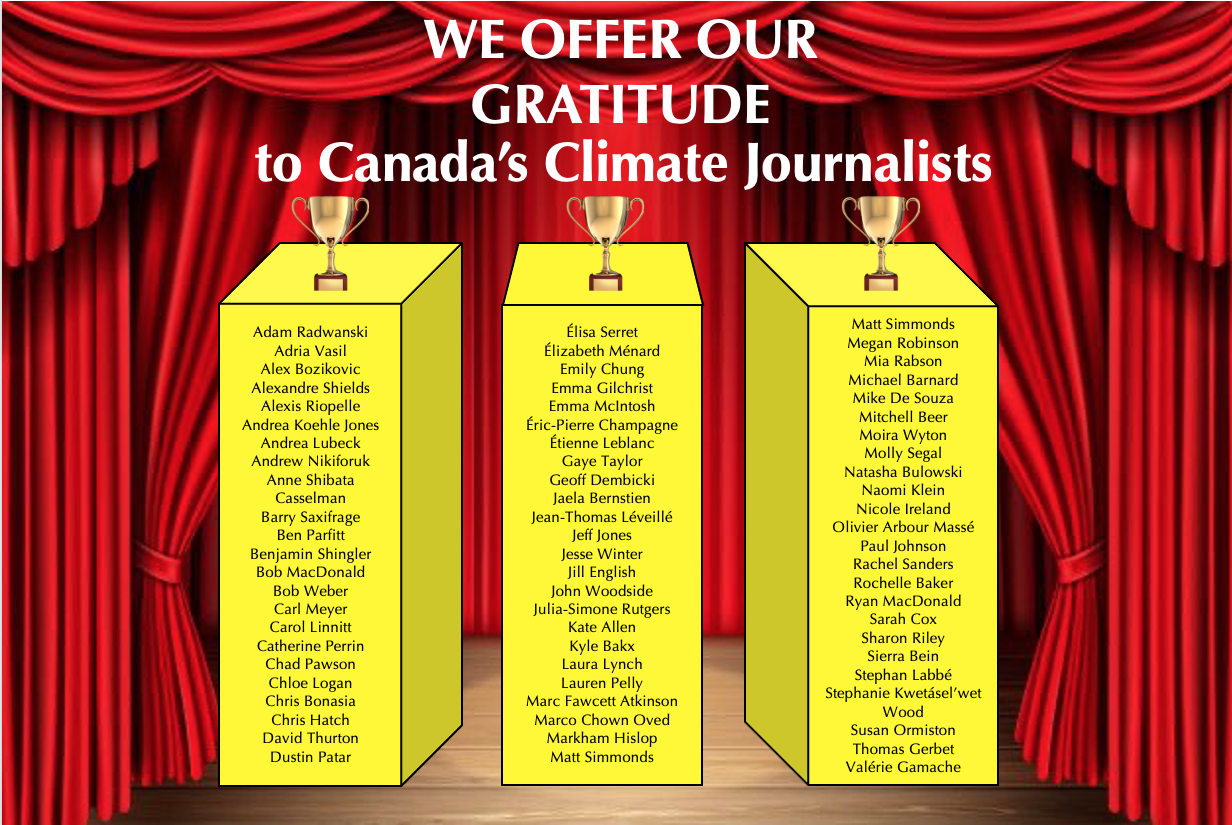
Without you, who work with such persistence in the trenches of the climate crisis, how would Canadians know that we face such danger?
How would we know that most of the solutions we need already exist, or that progress is being blocked by those who profit from continued climate pollution, and those who believe their lies?
We are truly blessed to have so many great climate journalists.
Without your work it would be hard to persuade our fellow Canadians that the climate crisis is real and urgent. And without public support, it would be hard to persuade our leaders that they need to tackle the crisis with far greater urgency.
Knowing that I speak on behalf of climate activists, scientists, and champions all across Canada,
we raise our hands to thank you.
THANK YOU!! YOUR WORK IS APPRECIATED
At 24 heures: Andrea Lubeck, Élizabeth Ménard.
At the CBC: Benjamin Shingler, Bob MacDonald, David Thurton, Emily Chung, Jill English, Kyle Bakx, Laura Lynch, Lauren Pelly, Kristin Nelson, Moira Wyton, Molly Segal, Rachel Sanders, Susan Ormiston.
At CBC Radio Canada: Catherine Perrin, Élisa Serret, Étienne Leblanc, Thomas Gerbet, Valérie Gamache, Olivier Arbour Massé.
At the Canadian Centre for Policy Alternatives: Ben Parfitt.
At Canadian Press: Bob Weber, Mia Rabson, Nicole Ireland.
At CleanTechnica & Forbes: Michael Barnard.
At Corporate Knights: Adria Vasil.
At Le Devoir: Alexandre Shields, Alexis Riopelle
At the Globe and Mail: Adam Radwanski, Alex Bozikovic, Jeff Jones, Ryan MacDonald, Sierra Bein.
At The Energy Mix: Chris Bonasia, Gaye Taylor, Mitchell Beer.
At EcoParent Magazine: Andrea Koehle Jones.
At Energi: Markham Hislop.
At Glacier Media: Stephan Labbé,
At Global: Megan Robinson.
At the Guardian: Naomi Klein.
As independent climate journalists: Andrea Koehle Jones, Anne Shibata Casselman, Dustin Patar.
At La Presse: Éric-Pierre Champagne, Jean-Thomas Léveillé
At the Narwhal: Carl Meyer, Carol Linnitt, Emma Gilchrist, Emma McIntosh, Fatima Syed, Jesse Winter, Julia-Simone Rutgers, Matt Simmonds, Mike De Souza, Sarah Cox, Sharon Riley, Stephanie Kwetásel’wet Wood.
At the National Observer: Barry Saxifrage, Chloe Logan, Chris Hatch, John Woodside, Marc Fawcett Atkinson, Natasha Bulowski, Rochelle Baker.
At the Toronto Star: Kate Allen, Marco Chown Oved.
At the Tyee: Andrew Nikiforuk, Geoff Dembicki.
Written and compiled by Guy Dauncey, climate author and organizer. Co-Chair of the West Coast Climate Action Network.
If you are a professional Canadian journalist who is researching and writing original climate stories and I have failed to include you, I apologize. Please let me know. guydauncey-at-earthfuture.com
This is an extract from Chapter 12 of my forthcoming book The Economics of Kindness: How to End the Economics of Selfishness and Build an Economy that Works for All, for which I am seeking a publisher.
So much has been written about the urgency of the looming climate disaster that I’ll skip straight to the solutions. I am a climate alarmist, just as Churchill was a Nazi alarmist in the 1930s. But I am not a climate doomer. I am of one mind with Paul Hawken, author of Regeneration: Ending the Climate Crisis in One Generation,who believesthat we can do this if we put our minds to it. The alternative is too dire to contemplate.
In his book, Value(s): Building a Better World for All, former governor of The Bank of England Mark Carney, looks at value beyond dollars and demands your attention. Review by Guy Dauncey. First published in The MINT Magazine, September 2021.
When the world’s best-known central banker writes a new book, we should sit up and pay attention, especially since Mark Carney is one of the few central bankers who really gets the climate crisis.
It’s a quite personal book; his writing reveals a deep commitment to ethical values, and service to the wider community. He makes me feel that I know him, and we’d get along well over a pint of beer. He often shares stories from his time at the Bank of England, and as chair of the Financial Stability Board, which was set up after the 2008 financial crash, resulting in over 100 reforms. Will they work? Time will tell.
There are massive forest fires in Siberia. Greenland’s melting is accelerating. Record heatwaves are roasting Europe. The world’s insects are dying off. The scary news keeps accumulating.
We are living on the edge of an emergency that is just getting started, and climate is only the half of it. There’s also an ecological emergency. How are we to respond? It’s easy to slip into complacency, or to be overcome by fear, followed by a sense of impotence. You know the crises are real, but the children are coming to visit, there’s a holiday to plan, and don’t get me started on the problems we’re having at work.
The first step to end complacency and neutralize fear is to put the crisis on your weekly to-do list:
Weed the garden
Visit your friend in hospital
Sign the kids up for karate/soccer/piano/dancing lessons
Do something to tackle the climate and ecological crises
Will you join me? I need lots of people to join the November Offensive, so that together, we can make a difference.
This summer’s forest fires and smoke-filled skies have left many of us asking, “What will it take to end the climate dithering and start DOING something to tackle the growing emergency?”
The IPCC has just reminded us of the urgency of the crisis, and the need to reduce emissions globally by 45% by 2030 if we are to limit the warming to 1.5C.
The BC NDP government is getting ready to launch its climate plan at the end of November, somehow combining climate action sufficient to meet its stated goal of a 40% reduction in emissions by 2030 with its recent climate-disastrous decision to approve the big LNG Canada project.
The timing is critical to impress our New Democrat and Green MLAs of the need for urgent action to speed the transition to 100% renewable energy and protect the forests.
Trudeau: ‘No country would find 173 billion barrels of oil in the ground and leave them there’
Trump: “We’ve got underneath us more oil than anybody … and I want to use it.”
I have very little to add to this. Emotionally, culturally, empathetically, educationally and behaviourally, Trump and Trudeau are as different as different can be. Trump is a bully, a braggard and a boor. Trudeau is a refined classical decoration on the carpet of civilization. Trump is a dirty stain.
Yet when it comes to energy and oil, their brains and their political instincts think alike. Trump is a proud climate denier. His “Grab them by the oil-wells” thoughts are at least consistent with his larger outlook, which is nationalist and mercantilist, as if the eighteenth century had never ended.
$4.5 Billion Dollars to Subsidize Fossil Fuels? Here’s a Much Better Idea
$4.5 billion of Canada’s money, to buy a bitumen pipeline? Some suggest that it could rise as high as $12 billion, including future construction and legal costs.
So what if the money was invested in solutions to the climate crisis, instead making things worse by being invested in the primary cause, which is our use of fossil fuels? When Canada signed the Paris Climate Agreement most people presumed that it was being signed honestly, not as an act of laugh-behind-your-hand hypocrisy.
Thirty to Fifty Times More Jobs
That much money could leverage enough electricity to replace most of Alberta’s coal and gas-fired electricity, and generate between 30 and 50 times as many jobs. It could also power 18 million electric vehicles for 25 years. Continue reading Canada’s Choice→



 The Practical Utopian