I am a speaker, author, activist and futurist who works to develop a positive vision of a sustainable future and to translate that vision into action.
I am founder of the BC Sustainable Energy Association, co-founder of the Victoria Car Share Cooperative, and the author or co-author of nine books, including the award-winning Cancer: 101 Solutions to a Preventable Epidemic and The Climate Challenge: 101 Solutions to Global Warming. My latest book is 'Journey to the Future: A Better World Is Possible' (December 2015). www.journeytothefuture.ca
For my sins, I am an Honorary Member of the Planning Institute of BC, a Fellow of the Royal Society for the Arts, and a Fellow of the Findhorn Foundation in Scotland. I live on Vancouver Island, BC, Canada.
View all posts by Guy Dauncey →
In BC’s October election, as a member of the Green Party, I am endorsing the NDP candidate for Ladysmith-Oceanside, Stephanie Higginson, hoping she will win.
This needs some explaining!
I met Stephanie when she came to my home to pick my brain about local environmental concerns, and I found her to be smart, alert, and committed. I think she’ll make a great MLA. She lives locally on a small farm in Cedar, and she has served our community on the Nanaimo-Ladysmith Board of Education, and as past president of the BC School Trustees’ Association.
Our Green Party candidate Laura Ferreira, on the other hand, appears to be a paper candidate. I’m sure she is great, but she does not live here, does not appear to be campaigning, and has not been attending election meetings. On October 9th, the website Canada 388 suggested that in our Electoral District the BC Conservatives are leading at 43%, with the NDP at 40% and the Greens at 12%.
This tells me that a vote for Laura is a wasted vote that could help the Conservative candidate get elected. If they win a majority and form the new government, the next four years willl be dire for everything I believe in:
They will be worse for climate action, since they have promised to scrap all of the government’s climate action plans and initiatives.
They will be worse for affordable housing, just leaving it to the market.
They will be worse for healthcare, allowing private care for wealthy people, which will siphon off doctors and nurses and make health care harder for everyone else.
They will be worse for BC’s forests.
They will be worse for building respectful relations with BC’s First Nations.
My primary loyalty is to the Earth, not to any one party. I am a Green Party member because that is where my heart is, and I support their approach on almost everything. They are the only party that promises to stop permitting new LNG projects, and to phase out fracking for fossil gas, both of which pour fuel onto the raging climate fire. As someone who has been working to slow the climate crisis for more than 20 years, I find the NDP’s careless attitude to fracking and LNG appalling.
I know the NDP has been split over this, with some NDP MLAs disliking their approach to LNG and fracking, but lacking a majority in caucus to be able to change things. This is why we need more green New Democrats to be elected. I perceive Stephanie to be a strong environmental advocate, which is why I am endorsing her.
There is a craziness afoot in British Columbia, and I’m not referring to the legions of homeless people who are camped out on our streets. I’m referring to the $3 billion of public money that is about to be spent on a transmission line to carry electricity from the Site C Dam to Prince Rupert. Are the good folks of Rupert planning to mine cryptocurrencies? Build a nuclear power plant? No. It’s a cryptocarbon-busting innovation they want to build, using a digital deception to transform fracked fossil gas into “the world’s cleanest LNG”.
Do you bank with Community Coastal Credit Union? If you do, congratulate yourself. A credit union is a financial cooperative that is – or could be, if you vote – controlled by its members, for your benefit and the benefit of the wider community.
As a shareholder, you have the right to vote for CCCU’s Directors – and the 2024 election is happening NOW!
In early days I found you bright,
We had good fun, and quick delight,
But now alas my love has curdled,
You have gone sour, my gentle wordle.

So farewell, we’ve had our kicks,
Wordle 1,078 3/6

With Blossom I have new love found,
and skills that grow with every round.
Twelve times each day I seek your pleasure,
Squandering my guilty leisure.
An S? An R? Four squealy Es?
Seeresses come! Our hearts to please.

And after, when our love is done,
I pause to ponder words not spun
I take a peak to seek out tricksters
And find ‘saururaceae’ from Merriam-Webster!
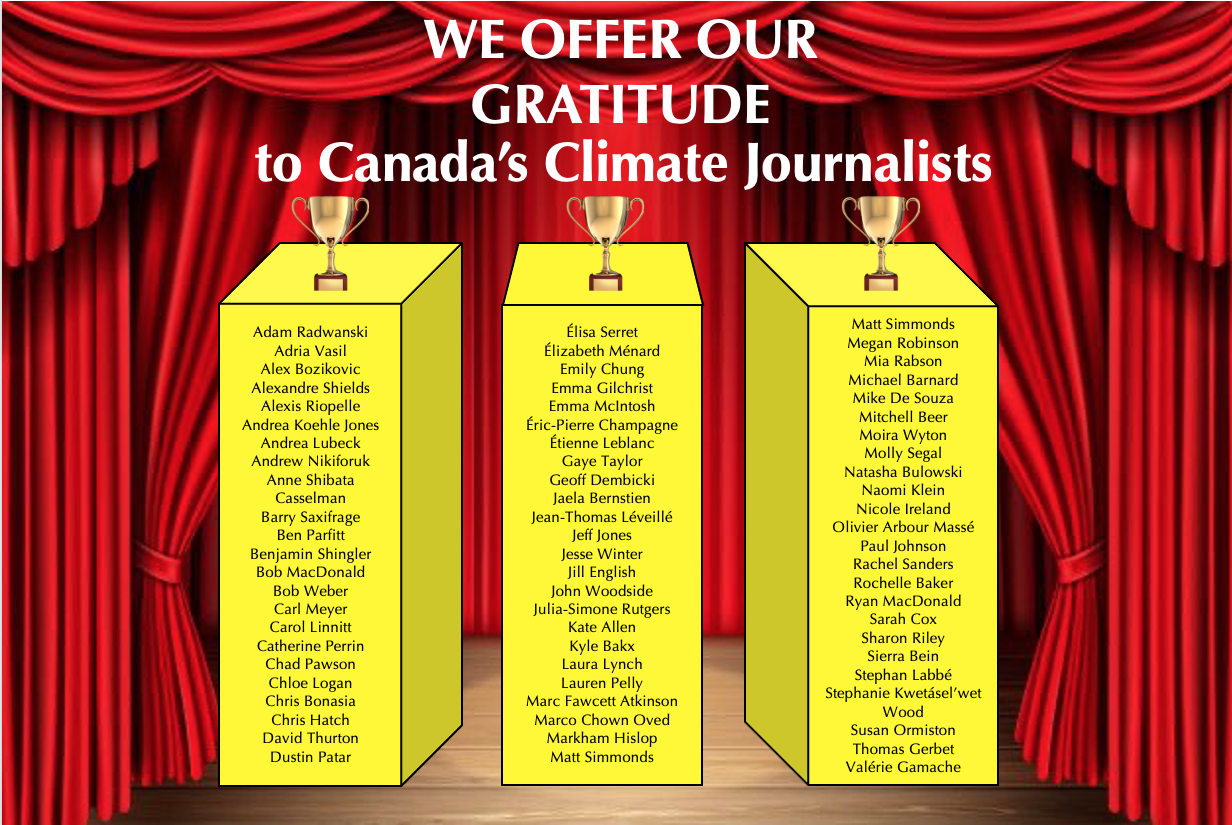
Without you, who work with such persistence in the trenches of the climate crisis, how would Canadians know that we face such danger?
How would we know that most of the solutions we need already exist, or that progress is being blocked by those who profit from continued climate pollution, and those who believe their lies?
We are truly blessed to have so many great climate journalists.
Without your work it would be hard to persuade our fellow Canadians that the climate crisis is real and urgent. And without public support, it would be hard to persuade our leaders that they need to tackle the crisis with far greater urgency.
Knowing that I speak on behalf of climate activists, scientists, and champions all across Canada,
we raise our hands to thank you.
THANK YOU!! YOUR WORK IS APPRECIATED
At 24 heures: Andrea Lubeck, Élizabeth Ménard.
At the CBC: Benjamin Shingler, Bob MacDonald, David Thurton, Emily Chung, Jill English, Kyle Bakx, Laura Lynch, Lauren Pelly, Kristin Nelson, Moira Wyton, Molly Segal, Rachel Sanders, Susan Ormiston.
At CBC Radio Canada: Catherine Perrin, Élisa Serret, Étienne Leblanc, Thomas Gerbet, Valérie Gamache, Olivier Arbour Massé.
At the Canadian Centre for Policy Alternatives: Ben Parfitt.
At Canadian Press: Bob Weber, Mia Rabson, Nicole Ireland.
At CleanTechnica & Forbes: Michael Barnard.
At Corporate Knights: Adria Vasil.
At Le Devoir: Alexandre Shields, Alexis Riopelle
At the Globe and Mail: Adam Radwanski, Alex Bozikovic, Jeff Jones, Ryan MacDonald, Sierra Bein.
At The Energy Mix: Chris Bonasia, Gaye Taylor, Mitchell Beer.
At EcoParent Magazine: Andrea Koehle Jones.
At Energi: Markham Hislop.
At Glacier Media: Stephan Labbé,
At Global: Megan Robinson.
At the Guardian: Naomi Klein.
As independent climate journalists: Andrea Koehle Jones, Anne Shibata Casselman, Dustin Patar.
At La Presse: Éric-Pierre Champagne, Jean-Thomas Léveillé
At the Narwhal: Carl Meyer, Carol Linnitt, Emma Gilchrist, Emma McIntosh, Fatima Syed, Jesse Winter, Julia-Simone Rutgers, Matt Simmonds, Mike De Souza, Sarah Cox, Sharon Riley, Stephanie Kwetásel’wet Wood.
At the National Observer: Barry Saxifrage, Chloe Logan, Chris Hatch, John Woodside, Marc Fawcett Atkinson, Natasha Bulowski, Rochelle Baker.
At the Toronto Star: Kate Allen, Marco Chown Oved.
At the Tyee: Andrew Nikiforuk, Geoff Dembicki.
Written and compiled by Guy Dauncey, climate author and organizer. Co-Chair of the West Coast Climate Action Network.
If you are a professional Canadian journalist who is researching and writing original climate stories and I have failed to include you, I apologize. Please let me know. guydauncey-at-earthfuture.com
Calvin Sandborn’s Speech on Retiring from the University of Victoria Environmental Law Centre
Delivered to 160 former law students, clients, and First Nations leaders, June 15, 2023
This summer I leave the Environmental Law Centre, but our work is far from finished.
We face an unprecedented crisis in biodiversity
And as I speak, Canada is on fire.
The question is unavoidable: Can we turn this around?
Realistically speaking, it looks very grim. And it is particularly grim because the public is divided about whether or not human-caused climate change is real.
But there is still hope. You can still imagine a pathway where we could:
Reduce greenhouse gases
Perhaps have some rough years
But then, 100 years from today – our great grandchildren could possibly inherit a stable climate. Perhaps an even better climate future than we have.
We must cling to that hope. We cannot surrender to Climate Fear. We cannot afford the luxury of pessimism. The stakes are too high for despair.
Our generation faces an existential choice. As the Youngbloods put it:
“We hold the key to love and fear in our trembling hands…One key unlocks them both you know, it’s at your command.”
The fundamental question facing each of us individually is the one posed by Plato:
“How then shall we live?”
How do we find meaning in our lives? How do we live a life of purpose in a world shadowed by fear?
Today, we can certainly learn from the courage and purpose that President Zelenskyy and Ukrainian people have forged.
“There can be no greater purpose than to work together to save the future of the human race. We have the opportunity to live lives of great purpose.”
But here’s the thing:
There can be no greater purpose than to work together to save the future of the human race. We have the opportunity to live lives of great purpose.
Future generations call out to us to have courage.
An ancient wisdom provides an answer to our dilemma. It counsels us to choose love and hope over fear and anger. In fact I would argue that in the struggle ahead we must be guided first by love – by a love of nature, and by love of all of our brothers and sisters – including those we don’t agree with on everything.
A loving approach is our surest way to a positive future for the human family – and the surest way to an individual life of purpose.
A famous Vermont environmentalist put it well. On her 100th birthday she was asked, “What advice can you give to the young – what is the secret of a meaningful life?” And she said quite simply:
“There are three things:
Love yourself.
Love others.
Love Nature.”
The greatest prophet of our age, the Rev. Martin Luther King, lived in times as divisive as our own, fighting some of the same political currents – and some of the very same people — that we face today.
It is important to remember that Reverend King brought down the entire fascist political system of the US South, while carrying a book of his sermons entitled simply, “Strength to Love”.
King called everyone to join together in a beloved community. He clung tenaciously to that vision, even when the Ku Klux Klan bombed his house where his wife and children lay sleeping.
An angry crowd of King’s neighbours gathered, many vowing revenge. One black man threatened a policeman with a gun, others brandished broken bottles. But King stepped out onto his shattered porch — which still smelled of dynamite — and called on his neighbours to love their enemies.
King repeatedly preached, “Segregationists are not our enemies, we will change their hearts.” In the end, his call for a “beloved community” changed a Nation’s heart — and the apartheid system collapsed.
Today, King’s approach is needed to heal the divisiveness of our times.
I remind you that King copied the philosophy of lawyer Mahatma Gandhi, who liberated India from the mighty British Empire. Gandhi put it this way:
“My goal is friendship with the world and I can combine the greatest love with the greatest opposition to wrong.”
In turn, another lawyer named Nelson Mandela utilized King’s methods to bring down Apartheid in South Africa.
“We here have a beloved community. We have been drawn to this room because we have fallen in love with the Earth – and with each other.”
The idea of a “beloved community” is as compelling an idea as any in history. We here have a beloved community. We have been drawn to this room because we have fallen in love with the Earth – and with each other.
We fell in love with nature in different ways:
We have seen the photos of Earth from space – a fragile blue-green emerald with a very thin layer of air, water and land that supports the only known life in the universe.
We have stood open-mouthed as the orcas leapt out of the ocean.
We have seen the heron silently stalk fish in a shallow lagoon at dawn.
We have seen the salmon runs — tragic as Shakespeare, joyful as Easter.
We have watched eagles clenched together, riding the updraft.
Indigenous elders have taught us to recognize Sister Cedar.
And they have taught us to welcome the Trout Children and “all of our relatives”.
We bonded with the natural world. We were touched in the deep heart’s core.
“If we are going to save Sister Cedar, the Trout Children and our grandchildren, we have to extend that beloved community to Conservatives, Republicans, and a whole bunch of people we may not agree with on other issues.”
Yes, we have fallen in love with the Earth, and with each other.
We found community as we hiked together in alpine meadows.
We found community as we sang songs around campfires.
We found community as we lay on the earth under a vast canopy of stars — talking half the night with our friends, our brothers, sisters, our community.
But now, if we are going to save Sister Cedar, the Trout Children and our grandchildren, we have to extend that beloved community to Conservatives, Republicans, and a whole bunch of people we may not agree with on other issues.
Like Martin Luther King we must win them over with the truth and a beautiful vision of a Common Future – a healthy planet, with a healthy climate, jobs, houses and food for all – and a healthy future for everyone’s kids.
If we are going to deal with the environmental crisis that we face, and if we are going to save the Earth and save the community of humanity, we must share:
our love for Nature and its beauties and wonders;
our love for the Future;
our love for our grandchildren;
our love for ALL PEOPLE; and
our common destiny.
As far as the climate fight goes, united we stand, divided we fall. We must all stand together, or we will all fry together. We cannot afford to allow the forces of reaction to mobilize people to vote against their interests by fanning grievances. We must fight “grievance politics” with the politics of a Beloved Community that we all share.
We must abandon finger-pointing, sneering, cynicism, and blaming other people – and invite all people to work together. The fact is that we are all in the same boat, all on the same Earth. We need a little less calling people out — and a whole lot more calling people in. We need to invite and persuade everyone to work together and keep this fragile boat from sinking.
In this existential quest to save the future, we need powerful voices to speak. Nature needs lawyers to give voice to the river and to the forest. We need voices to speak for the grizzly and the marmot. We need voices to speak for the caribou and the falcon. Finally, we need voices to speak for climate and future generations.
“If you succeed you will be heroes to coming generations.”
We need our own Gandhis and Mandelas.
All of you – law students, lawyers, community leaders and community activists –you have a grand opportunity to work together now, to work in community to save the natural world. And no life can be more meaningful, more full of purpose, more satisfying, than to work to save our Earth in this time of its greatest peril.
If you succeed you will be heroes to coming generations. A future Shakespeare may write of our beloved community:
“This story shall every good parent teach their child;
And Crispin Crispian shall ne’er go by,
From this day to the ending of the world,
But we in it shall be remember’d;
We few, we happy few, we band of brothers and sisters…”
Of course, if we fail, that will be tragic. Yet, still, we will have had moments of beauty, moments of loving each other, of building community, of a noble quest more consequential than Star Wars.
At the least, we will have lived lives of purpose.
And if we create a loving community, if we reach out to the broader community with a positive message, humanity has a much better shot at actually making it through to a beautiful future for everyone’s grandchildren.
You can do this – you stand on the side of truth, and of love, and of community and the Earth. Remember, by protecting the Earth, you, like Gandhi, are friends of all, you’re the friends of the future.
Epilogue
And finally, now that I am old, let me take the liberty to offer a few brief tips:
First of all, learn from your clients – the community heroes that donate thousands of hours of unpaid time to fight for our land, air and water. They include some of the smartest – and I daresay, most noble — people you will ever meet.
Listen to the elders. One of the most fortunate things in my life has been the opportunity to learn from the wisdom of the resurgent Indigenous peoples of British Columbia.
Make friends and allies everywhere, and enemies nowhere. Avoid the backbiting and division that has destroyed so many organizations and movements.
Build bridges with the visionaries in business, government and elsewhere. There are like-minded people “on the other side”. Don’t write people off. Win them over!
Have fun! Dance. Play music. Share joy with others. Love each other. It is in community that we break the epidemic of alienation that drives environmental destruction.
In closing, it is clear that the environmental crisis is daunting. The work will not be easy.
But take heart. As Martin Luther King told us, the arc of history is long – but it bends towards justice. We shall overcome.
“Because we all share this planet Earth, we have to learn to live in harmony and peace with each other, and with nature. This is not just a dream. It is a necessity.”– The Dalai Lama[1]
Our world needs more kindness. People need more kindness. Nature needs more kindness. But we need it deep within our economies, where so many of our troubles begin.
We have been told a thousand times that the free-market economy is the best and only kind of economy that works, but for so many people, and for nature, it’s not working. Surely, there must be a better way. Our capitalist economy has been built on the primacy of selfishness, and all around the world, because of this, things are going off the rails. What is the alternative? It’s the economics of kindness – and it’s not just an idea. It’s a very real thing.
Before we begin, we must answer the question that’s causing so much anxiety:
“What’s going wrong? Why is our world in such a mess?”
This is an extract from Chapter 12 of my forthcoming book The Economics of Kindness: How to End the Economics of Selfishness and Build an Economy that Works for All, for which I am seeking a publisher.
So much has been written about the urgency of the looming climate disaster that I’ll skip straight to the solutions. I am a climate alarmist, just as Churchill was a Nazi alarmist in the 1930s. But I am not a climate doomer. I am of one mind with Paul Hawken, author of Regeneration: Ending the Climate Crisis in One Generation,who believesthat we can do this if we put our minds to it. The alternative is too dire to contemplate.
To the left of me, to the right of me, in front and behind, I see people giving up on the belief that we can change the world.
Saying awful things about humanity, fearing awful things about the climate crisis, feeling awful things about the future. Feeling panic. Feeling trapped. Good people, kind people, thoughtful people, drowning under all the bad news. Just can’t see a way forward. Concluding that it’s all too late.





 The Practical Utopian